
Today, we are excited to announce the release of RustFS Beta.
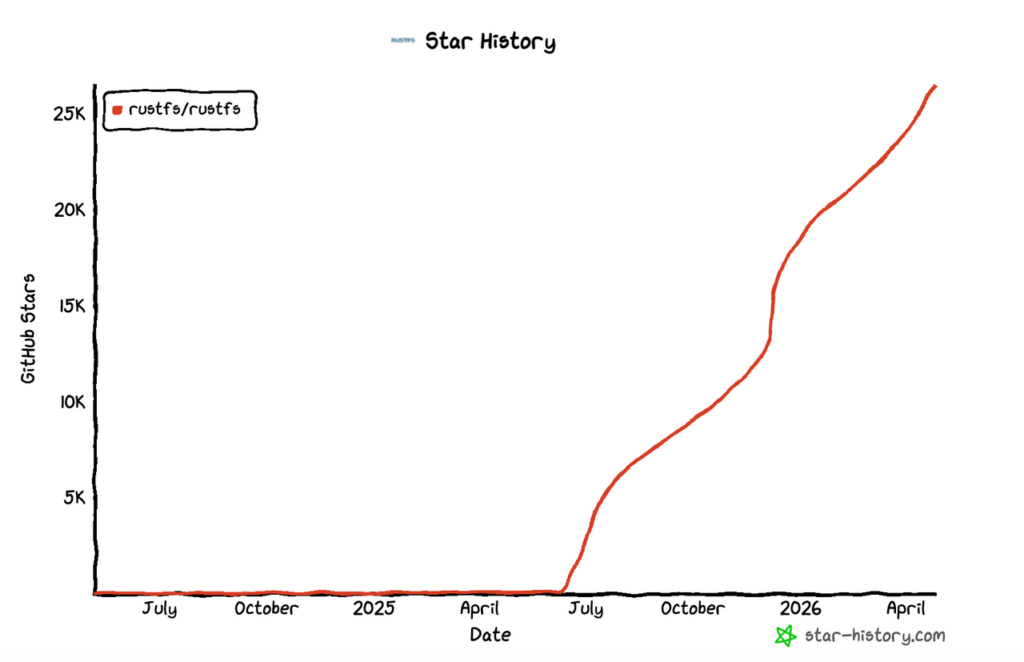
Built as a distributed object storage system for the AI era, RustFS has seen remarkable growth since being open sourced in July 2025. In less than a year, RustFS has reached 26.5K GitHub stars, 1.1K forks, and attracted 130+ contributors worldwide. Our DockerHub images have surpassed 2.2 million pulls, while RustFS has ranked #1 on GitHub Trending eight times and topped GitHub Rust Trending more than 40 times.
These milestones have made RustFS one of the fastest-growing open-source object storage projects.
After 2,800+ Git commits and 100 Alpha releases, the project has matured significantly in architecture, stability, and ecosystem readiness. Based on this progress, we believe the project is ready to move from Alpha to Beta .
The RustFS Beta release marks an important milestone in our journey to build a high-performance, cloud-native, distributed object storage platform designed for modern AI and data-intensive workloads.
Why Beta Matters
RustFS is a distributed object storage system written entirely in Rust and released under the business-friendly Apache 2.0 license. As the landscape of open-source storage shifts—most notably with MinIO’s move toward more restrictive licensing—the global community is searching for a truly open, S3-compatible platform.
Learn how to migrate from MinIO to RustFS with Drop-in Binary Replacement feature.
RustFS fills this gap by delivering high performance, distributed erasure coding, and advanced security, ensuring developers and enterprises can build without the fear of vendor or license lock-in. This Beta release marks a new stage of maturity, signifying that RustFS is now ready for broader real-world adoption and production validation.
RustFS Core Features
RustFS Beta delivers a robust set of enterprise-grade features, including:
- Fully S3 Compatibility: Comprehensive object lifecycle management with seamless integration for a S3-compatible ecosystem.
- Security First: Built-in support for mTLS, KMS, and OIDC identity management.
- High Availability: Distributed clustering with multi-node and multi-disk support.
| Capability Grouping | Core Capabilities |
| S3 storage | Bucket/Object lifecycle management |
| Object Versioning and Object Lock | |
| Distributed Erasure Coding | |
| Multipart upload | |
| Checksums and integrity verification | |
| Compliance & Security | IAM users, groups, policies, and service accounts |
| OIDC login and web identity | |
| KMS service | |
| SSE-S3、SSE-KMS 以及 SSE-C | |
| STS | |
| mTLS | |
| Security audit | |
| Operation & Observibility | Event notification |
| OTEL | |
| Storage Capacity Monitoring | |
| Cluster node health check | |
| rc(rustfs client command line) | |
| MinIO migration | |
| Protocol | S3 |
| WebDAV | |
| Swift API | |
| FTP(s) | |
| High Availability | Distributed Clustering (Multi Node Multi Disks) |
| Node Healing, Scaling, and Rebalancing | |
| Cloud Native | Helm Chart |
| Operator | |
| AI | MCP Server |
Getting Started with RustFS
RustFS supports multiple operating systems, including Linux, macOS, and Windows, as well as multiple deployment methods such as binary installation, Docker, Helm Charts, and the RustFS Operator.
Using Linux as an example, getting started with RustFS is straightforward:
- Binary installation
Run the following command to install RustFS:
$ curl -O https://rustfs.com/install_rustfs.sh && bash install_rustfs.sh- Docker installation
$ docker pull rustfs/rustfs:latest
$ docker run -d \
  --name rustfs \
  -p 9000:9000 \
  -p 9001:9001 \
  -v /data:/data \
rustfs/rustfs:latest- Helm installation
# add Helm repo
helm repo add rustfs https://charts.rustfs.com

# Install RustFS
helm install my-rustfs rustfs/rustfs --version 0.0.99
For detailed installation instructions and deployment guides, please refer to our documentation.
What’s next
The Beta release marks an important milestone for RustFS, but it is only the beginning.
Looking ahead, we will continue investing in performance optimization, security hardening, and enterprise-grade high availability, making RustFS even more stable and production-ready as we work toward our planned General Availability (GA) release in July .
Our goal remains clear: to build a modern, high-performance distributed object storage system designed for AI and data-intensive workloads.
We welcome you to try RustFS in your own environments, share feedback through GitHub Issues, and contribute through star, issue, as well as pull requests.
- RustFS GitHub Repo:https://github.com/rustfs/rustfs
- RustFS client GitHub Repo:https://github.com/rustfs/cli


